
Planning for Solar Panels – Part 1

We are hoping in a couple of years to take a gap year! all out kids will have either left home or be at Uni, so time for old’s to go on an adventure. To enable us not to have to run the engine to charge the batteries, we are looking at solar panels.

On our latest trip to the boat I took some measurements of the available space on the roof that we could use for solar panels, we cannot use the area behind the centre line point as we have ropes and mounting for the pole, boat hook and our plank.
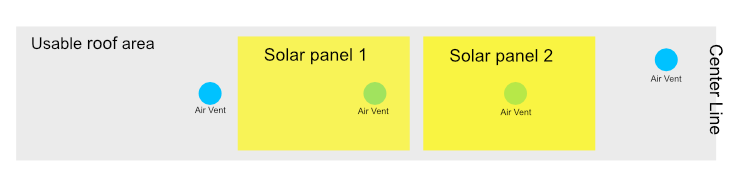
I have been looking at large panels that can deliver 400+ watts, this make the roof more difficult to walk on, but with just two fitted we can still layout on the roof and watch the stars and we don’t tend to walk on the roof, the knees won’t take the jump down.

This diagram is based on using two 415W Perlight Delta panels, which are 1719mm long x 1140mm wide and 30mm thick. I am hoping that a combined 830W will give me enough power in the summer, while providing some still usable power in the winter (More on my calculations in a future post).

We currently have two 12v TV’s (not often both used, but one in the bedroom and one in the lounge) , a 12V fridge, 240V washing machine, a hungry 3500W inverter, LED Lighting, water pumps, internet wifi/router, laptops and phones and about 400 Ah of lead acid batteries, so about 200 Ah usable power (an upgrade to Lithium will come one day).

We want to plan ahead and have more supply than we currently need, hoping to cover us for future needs and upgrades.

Next I want to find mountings that will go as low as possible, but still enable us to angle the panels for better output, especially in winter when the sun is low to the horzion.

Also see
Planning for Solar Panels – Part 1
Planning for Solar Panels Part 2 – Panel Mounting Options
Planning for Solar Panels Part 3 – Types of Panels
Planning for Solar Panels Part 4 – MPPT vs PWM solar controllers
Planning for Solar Panels part 5 – Cable sizes, lengths and resistance.
Planning for Solar Panels part 6 – Panels in Serial or Parallel
Planning for Solar Panels part 7 – Buying the cable and Circuit breakers
Planning for Solar Panels part 8 – Buying Solar Panels and Mountings
Planning for Solar Panels part 9 – Wiring
Planning for Solar Panels part 10 – Drilling, Tapping and Fitting


Safety Disclaimer

New Macerator Pump Fitted

A couple of weeks ago we visit the Marina fit more new curtains and measure the roof to find the best options for solar panels. Unfortunately we found the toilet was not working as expected, it would flush, but after flushing there would be more water in the bowl that expected, and after a second flush it would increase again.

We tried cleaning the toilet and using a plunger to push the water into the tank, but we could not resolve the problem and so had decided put it off to another visit, when I would have more time and tools.

On the way home I decided to texted Steve Cowham, who had come to our rescue fitting the water pump in the summer, I have poorly thumbs and am trying to save myself from further operations, luckily Steve was able to take a look and soon called me back.

Tecma 12V Silence / Elegance Macerator PumpHis suggestion was that the Macerator Pump had probably worn out, having been an X-Black Prince hire boat for 12 years, it would have been well used. He was happy to fit one for us and recommend we order one from Midland Chandlers the part we needed was a “Tecma 12V Silence / Elegance Macerator Pump” part number TG-224.

This was ordered and shipped directly to Steve via the marina, at £249.50 they are not cheap, but they need to work.

A few days later it is all fitted and working, we will be back to the boat soon and I am sure we will be testing it.

Steve, don’t forget to send us the bill, thanks 🙂

Winter Frost Protection Year 2

Last year we set the boat up with two thermostats, a normal one that controls the Eberspächer D4W diesel heater when we need it, initially the heating was just a switch on/off. I also fitted a frost thermostat both of these have a switch so they can be taken out of circuit.

Frost Thermostat
Frost Thermostat

So this year we made sure the diesel tank was fully topped up switch in the frost thermostat as low as I could above freezing (about 2°C).

Update Feb 2023 – This seems to have worked well again this year, we have used a few gallons of diesel, but the boat seems to be free of any frost damage.

New Curtains

After a trip to Ikea where we selected some new curtains, that will need to be shortened and adapted, each original made 3 new curtains for the boat after cutting and a new heading tape was fitted.

Sonia is a dab hand at making and adapting these for the boat and these are much more lively than the originals.

This one is in the lounge area, and the ones in the bedroom areas have been fitted with a blackout lining so we can sleep in on bright sunny summer morning…

Batteries and Battery Monitors Part 4 – Battery Monitor & The Shunt

Our Battery Monitor

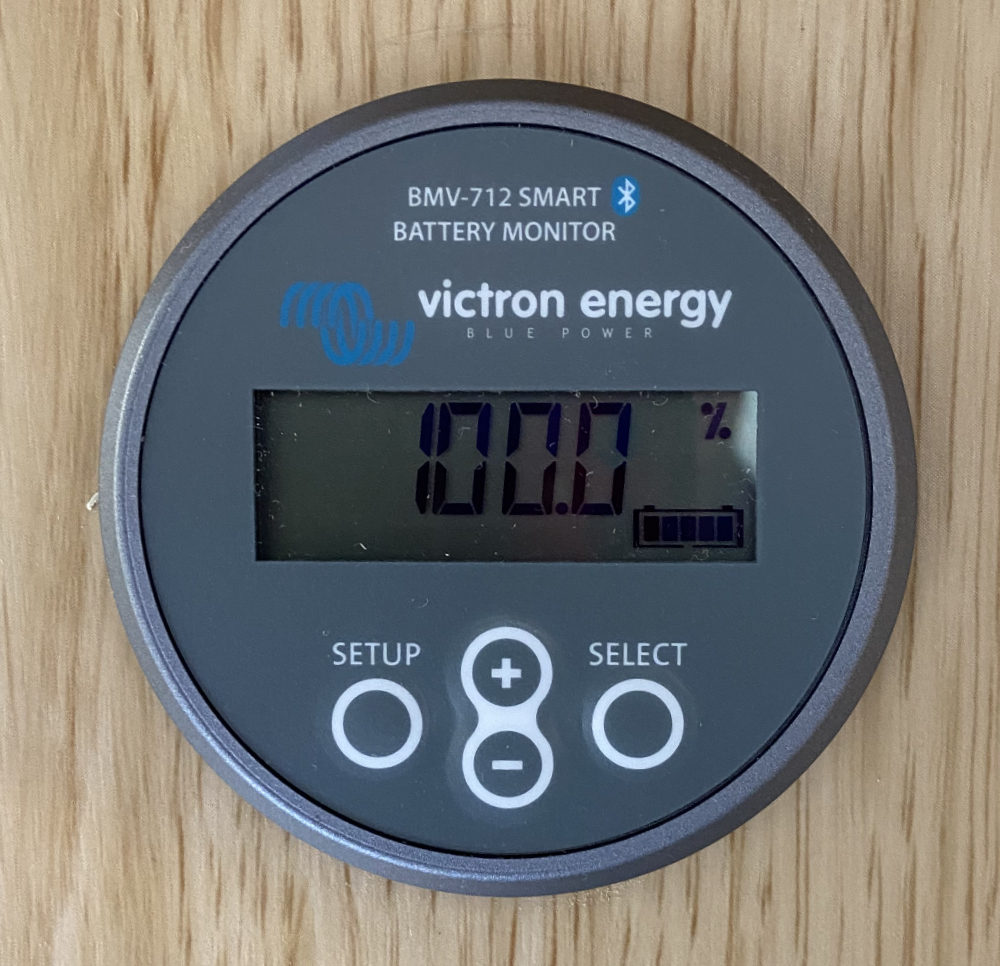
I have installed a Victron Energy BMV-712 Smart battery monitor, but there are many other options from other manufacturers, see the listing at the end of this article.

I selected this one as it gave me the opportunity to connect to my onboard Raspberry Pi which I am using to give some smart boat features and provide live location tracking for my website in the future.

Our Battery Monitor Display

The battery monitor comes in two parts, a display which provides a readout of the battery status and a means of programming/setting up the system for your configuration.

The Shunt

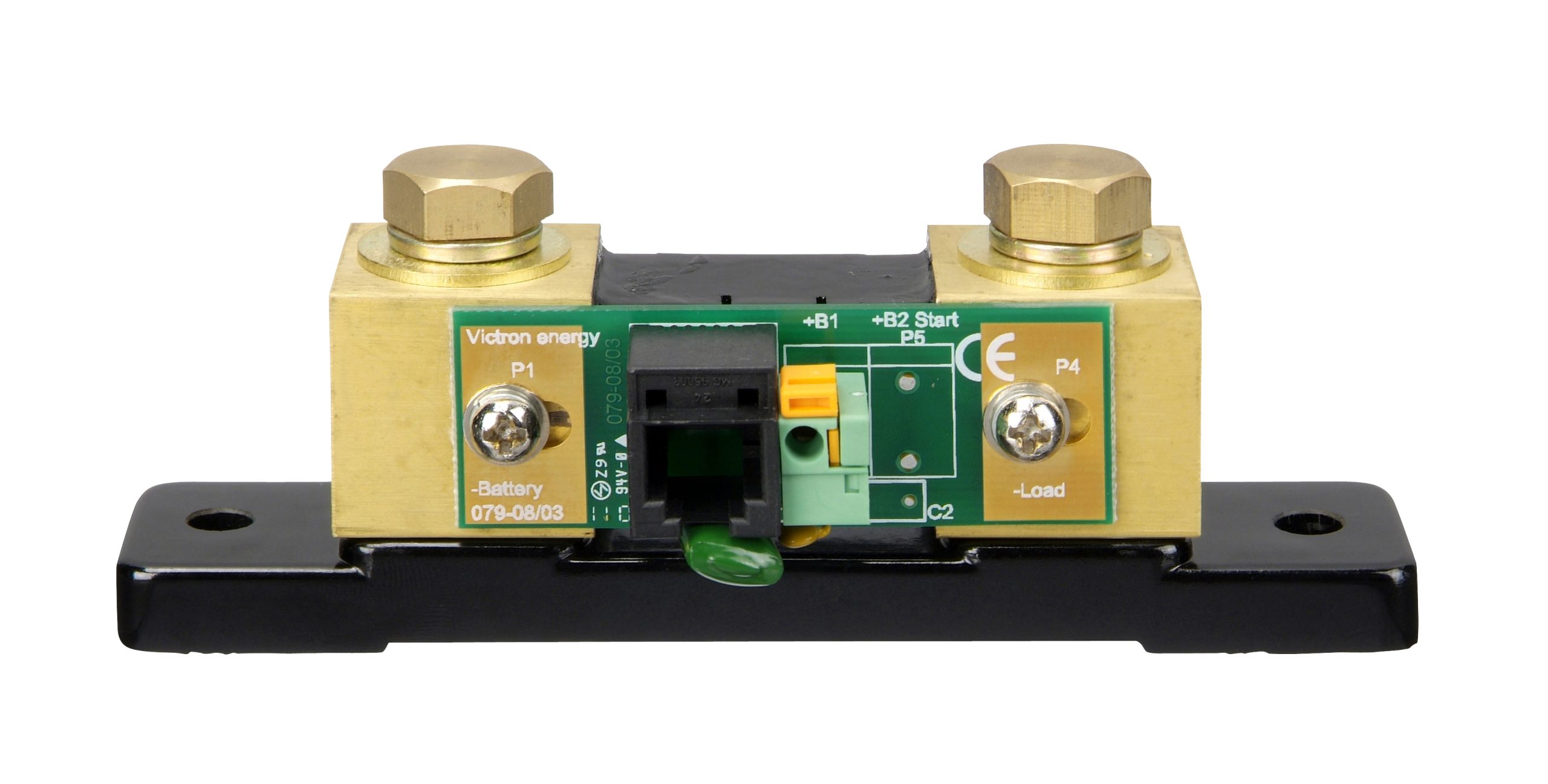
Victron Shunt
Victron Shunt (c)Victron

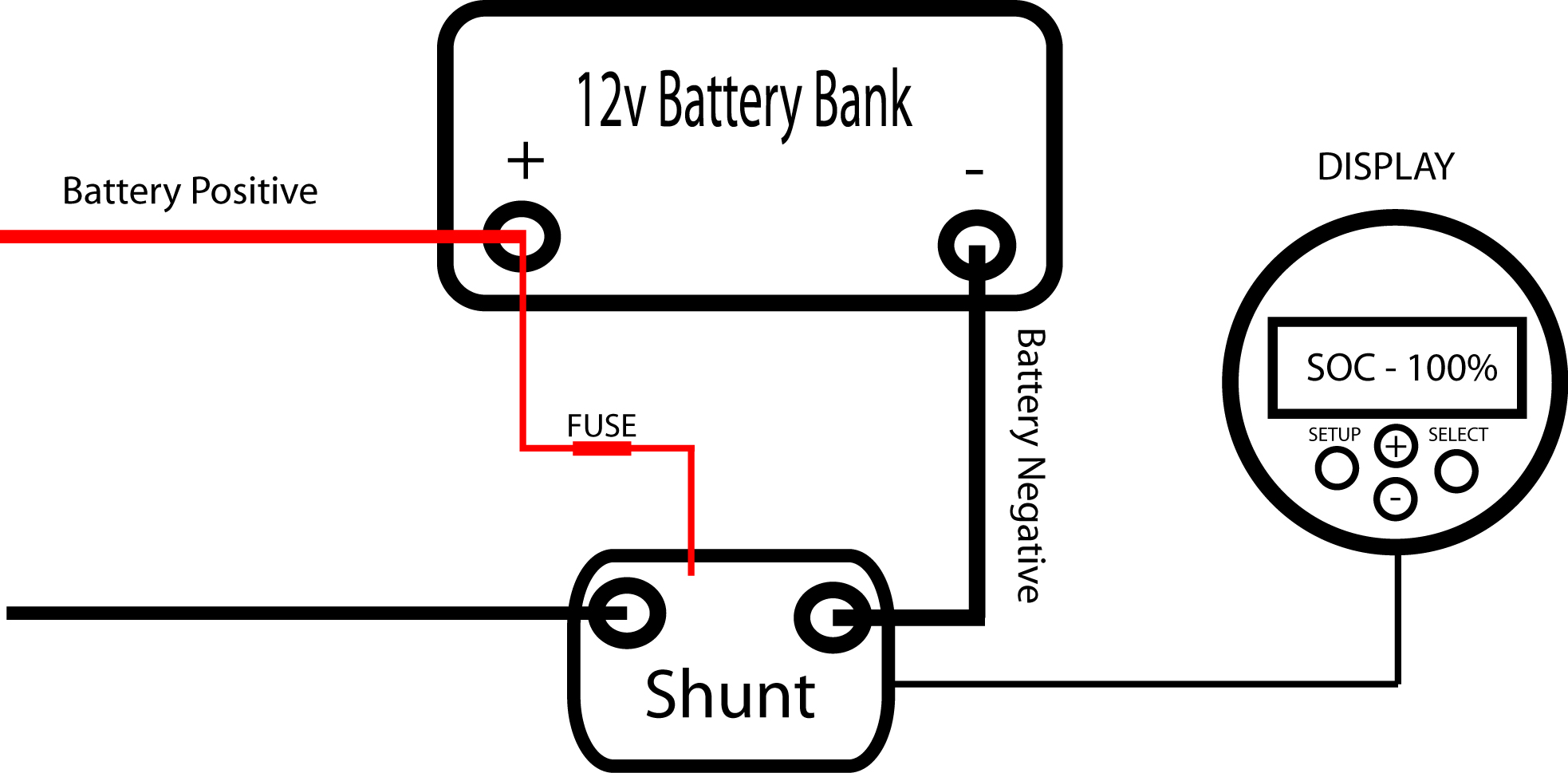
The second part is called a shunt, this needs to be placed, in our case, on the negative side of the battery bank, so that everything must pass through it to reach the battery, there should be no other connections to the negative side of the batteries else your measurements will never be accurate.

A shunt is a resistor of very low but known value that is placed in parallel with a voltmeter so that all the current being measured flows through it. The voltage drop across the shunt’s resistor is measured; this voltage drop across the shunt is proportional to the current flowing and can then be calculated using Ohms law (Current = Volts / Resistance).

Shunts are rated for the maximum current they can measure, in our case 500A which at 12V is 6000W, more than enough for our boat.

Basic Battery Monitor Wiring

The battery monitor also has an extra cable that connects to the positive side of the battery bank to power the electronics and the display, but also to measure the current battery voltage, we have an extra wire connected to the starter battery, so we can monitor its voltage as well.

Peukert’s Law

To then calculate the remaining capacity of the battery, the monitor uses an adaptation of Peukert’s Law** which can be used to calculate the capacity of lead acid batteries at different rates of discharge.  As we discussed earlier, the discharge rates affect the battery capacity.

** Developed by Wilhelm Peukert (1855-1932) Peukert’s law is used to calculate the batteries deliverable capacity at the current given rate of discharge, His law describes the batteries capacity at a constant discharge until it reaches its cut off voltage, below which you can damage your battery, this constant is called ‘K’, for example K=1.25 is used for our flooded lead acid batteries. There are however some limitations to this law as it does not consider the batteries temperature or age. I expect each monitor manufacturer modifies this to consider these extra factors when displaying the results, our system records each battery charge/discharge cycle.

The capacity of a battery falls at higher rates of discharge because the chemical reaction within the battery reaches its maximum speed for the given plate size and therefore the voltage drops. If left to recover, that missing capacity will return.

Using these calculations, a battery monitor can calculate the available power remaining while the battery is in use (under load) and as that load changes or even as the battery is charging, it can display the current State of Charge (SOC).

Now you know what is happening?

Armed with this information, you can then decide how you want to operate your boat and if you will need to start the engine to charge the batteries. One of our future projects is to work out the size we need for some solar panels, and we will use the data from the battery monitor to help calculate the size system we need, but that is a topic for another day

Battery Monitors Suppliers

Victron – www.victron.com
NASA Marine Instruments – www.nasamarine.com
Advanced Yacht Systems – www.advanceyacht.co.uk
Simarine – simarine.net/
Votronic – www.votronic.de

Safety Disclaimer